Windham County Dog Registration Information
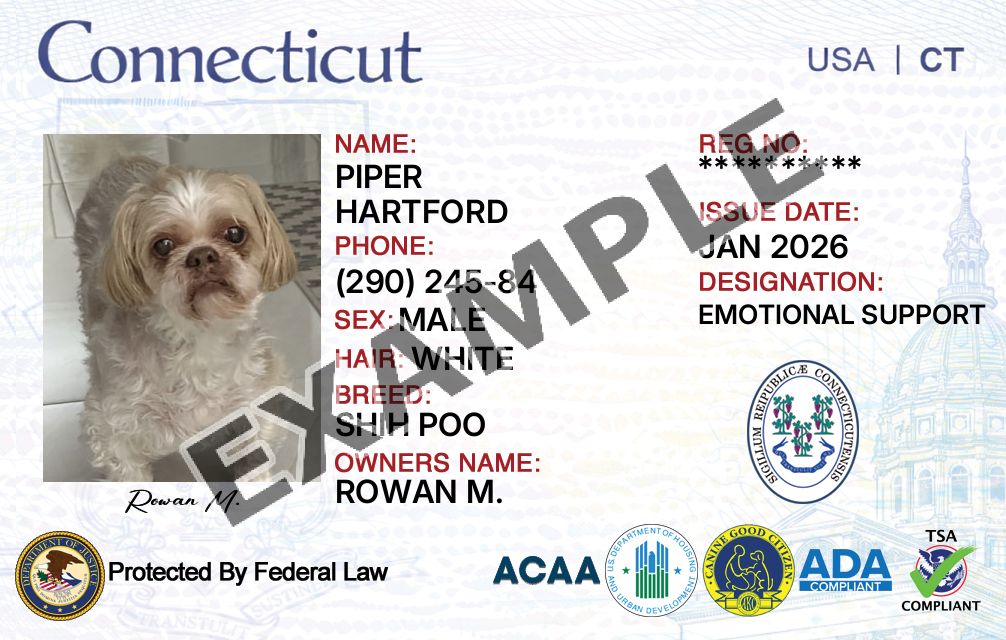
Service Dogs and Emotional Support Animals in Windham, Connecticut
If you’re searching for where do I register my dog in Windham County, Connecticut—especially for a service dog or emotional support dog—the key point is that dog “registration” in Connecticut is usually handled as a local dog license issued by the town where you live. Windham County has many municipalities, so the exact office depends on your town of residence (for example, Windham/Willimantic, Woodstock, Putnam, Killingly/Danielson, Brooklyn, Pomfret, Thompson, and others).
This page explains dog licensing requirements in Windham County, Connecticut, what documents you’ll typically need, how licensing relates to animal control, and what is (and is not) required for service dogs and emotional support animals.
Where to Register or License Your Dog in Windham County, Connecticut
In Connecticut, dog licenses are typically issued by the Town Clerk in the town where the dog is owned/kept, while Animal Control helps enforce animal-related laws and may answer questions about bites, stray dogs, and licensing compliance. Because Windham County is made up of multiple towns, below are verified official offices serving residents within Windham County (not a complete list of every municipality).
Town of Windham — Town Clerk (Licensing Office)
Notes: If you live in the Town of Windham (including Willimantic), start with the Town Clerk for licensing questions and paperwork submission.
Town of Windham — Animal Control (Willimantic Police Department Division)
Notes: Windham Animal Control lists dog licensure among the state animal laws it enforces and can be a helpful point of contact for animal services questions.
Town of Woodstock — Town Clerk (Dog Licensing)
Notes: Woodstock’s Town Clerk provides specific local dog licensing details (including renewal timing and where to mail/drop off documents) for Woodstock residents.
Overview of Dog Licensing in Windham County, Connecticut
How licensing works (county vs. town)
Even though you may search for “animal control dog license Windham County, Connecticut,” licensing is generally handled at the town level across Connecticut. Windham County contains multiple towns, and each town’s licensing office (commonly the Town Clerk) issues the local dog license and dog tag.
Typical statewide baseline rules you’ll see locally
- Age threshold: Many Connecticut towns license dogs once they are over six months old.
- Annual cycle: Commonly, dog licenses are renewed annually and tied to a June 30 deadline (many towns treat June as licensing/renewal month).
- Proof of rabies vaccination: Towns commonly require a current rabies certificate (showing expiration date) to license or renew.
- Fees vary by town: Fees can differ by municipality and may depend on whether the dog is spayed/neutered and other local policies.
What You Need Before Registering a Dog
Documents commonly required
While the exact requirements can differ by municipality within Windham County, Connecticut, most town clerks will ask for the items below before issuing a new license or renewing an existing one.
- Rabies vaccination certificate showing a valid vaccination and expiration date
- Spay/neuter documentation (if applicable) to qualify for a reduced fee where offered
- Owner identification and sometimes proof of residency (varies by town)
- Dog description details (breed/color/sex/age) that appear on the application
- Payment for the licensing fee (method depends on town; some allow mail/drop box/in-person options)
Service dog and emotional support dog paperwork: what applies
If your dog is a service dog or an emotional support animal (ESA), you generally still complete the standard dog license process with your town. Some towns may have special handling or fee rules for service dogs, but there is not one nationwide registry that replaces local licensing. If a local clerk asks questions about service animal status, keep your answers focused on the dog’s trained tasks (service dog) or your housing-related documentation (ESA), as appropriate.
Steps to Register or License a Dog in Windham County, Connecticut
Step 1: Identify your town licensing office
The most accurate answer to “where to register a dog in Windham County, Connecticut” is: your town’s Town Clerk (or the town office designated to issue dog licenses). If you live in the Town of Windham (Willimantic), use the Town of Windham Town Clerk. If you live in Woodstock, use the Woodstock Town Clerk. Other Windham County towns have their own town clerk offices.
Step 2: Confirm timing (new license vs. renewal)
- New dog: You’ll typically provide a rabies certificate and any spay/neuter documentation when applying for the first time in that town.
- Renewal: Many towns renew annually; commonly renewals are handled in June with a deadline around June 30, and late renewals may add penalties.
Step 3: Gather documents and submit your application
Submission options vary by municipality. Depending on where you live in Windham County, Connecticut, you may be able to apply:
- In person at the Town Clerk during business hours
- By mail with copies of required documents and payment
- By drop box (some towns provide an official drop box)
- Online (sometimes renewals only) if the town offers it and your rabies information is current on file
Step 4: Keep your tag and records accessible
Once your dog is licensed, you’ll receive a dog tag (and sometimes a paper license record). Keeping a copy of the rabies certificate and the license record can help if you need to show compliance for housing, boarding, or other local requirements.
Service Dog Laws in Windham County, Connecticut
Service dog status vs. dog licensing
A service dog is generally a dog individually trained to do work or perform tasks for a person with a disability. That legal status is different from a town dog license. In other words:
- Service dog: A disability-related working animal with specific task training.
- Dog license in Windham County, Connecticut: A local municipal license required for dogs kept in the town (applies broadly, including many working dogs).
No universal registry requirement
There is not one official, universal federal registry that you must use to “register” a service dog. In practice, service dog owners typically meet the same local dog licensing requirements (like rabies vaccination proof) and then rely on the dog’s training and behavior to establish service dog access rights where the law applies.
How towns may handle service dog licensing
Some Connecticut towns may have special fee rules or a specific process for service dogs (for example, how a clerk records the dog type). If your clerk asks for clarification, it’s reasonable to ask what documentation (if any) they accept for a local licensing classification, and whether any reduced-fee or no-fee service dog license rules apply in your town.
Emotional Support Animal Rules in Windham County, Connecticut
ESA status is not the same as a service dog
An emotional support animal (ESA) can be part of a person’s treatment plan for a mental or emotional disability, typically documented by a qualified healthcare professional for specific legal contexts (most commonly housing). ESAs are not the same as service dogs because they are not required to be trained to perform disability-related tasks.
How ESAs relate to dog licensing
Even if your dog is an ESA, local municipal rules may still require a dog license in Windham County, Connecticut based on where the dog is kept. That means you should plan to license your ESA through your town’s licensing office with the usual rabies vaccination proof and any other town requirements.
Quick comparison: Dog license vs. service dog vs. emotional support animal
| Category | Dog License (Municipal) | Service Dog | Emotional Support Animal (ESA) |
|---|---|---|---|
| What it is | A local license/tag issued by your town for dogs kept in that municipality. | A dog trained to perform tasks for a person with a disability. | An animal that provides emotional support; usually relevant to housing accommodations. |
| Where you “register” | Your town licensing office (commonly the Town Clerk) in Windham County, CT based on your town. | No universal federal registry; legal status is based on training and disability-related tasks. | No universal federal registry; status is typically supported by healthcare documentation for housing. |
| Common local requirements | Proof of rabies vaccination; renewal timing; fee payment; dog details. | May still need a municipal dog license and rabies compliance like other dogs. | May still need a municipal dog license and rabies compliance like other dogs. |
| Primary legal purpose | Local identification, vaccination compliance support, and municipal animal control administration. | Public access rights in covered settings when accompanying the handler (subject to legal rules). | Housing accommodation context (rules differ from public access and typically do not grant broad public access rights). |
| Typical “proof” people keep | Town-issued tag and license record; rabies certificate. | Training records are not universally required by law, but many handlers keep training documentation; rabies and license records help with local compliance. | Housing-related documentation from a qualified professional (as applicable) plus rabies and license records for local compliance. |
Frequently Asked Questions
Local reminder
Because requirements can vary by municipality within the county, always confirm your town’s current dog licensing requirements Windham County, Connecticut (fees, deadlines, and acceptable documents) with your local licensing office.
What You May Need
Disclaimer
Local laws, fees, office locations, and contact details can change. Residents should verify the most current information with their local animal services or licensing office in Windham County, Connecticut.
Register A Dog In Other Connecticut Counties
Select your county below to get started with your dog’s ID card. Requirements and license designs may vary by county, so choose your location to see the correct options and complete your pup’s registration.
- Capitol County Dog Registration
- Connecticut's eight historical counties County Dog Registration
- Fairfield County Dog Registration
- Greater Bridgeport County Dog Registration
- Hartford County Dog Registration
- Litchfield County Dog Registration
- Lower Connecticut River Valley County Dog Registration
- Middlesex County Dog Registration
- Naugatuck Valley County Dog Registration
- New Haven County Dog Registration
- New London County Dog Registration
- Northeastern Connecticut County Dog Registration
- Northwest Hills County Dog Registration
- South Central Connecticut County Dog Registration
- Southeastern Connecticut County Dog Registration
- Tolland County Dog Registration
- Western Connecticut County Dog Registration